As an Amazon Associate this site earns from qualifying purchases.
Side-by-side comparison
| Product | Price | Tiers | Dimensions | Shelf material | Anti-tip hardware |
|---|---|---|---|---|---|
| Kitsure Over Toilet Storage Rack | Check price on Amazon | 3 mesh | 63.2" H | Carbon steel | 2 wall-fixing kits, 4 leveling feet |
| Kalrin Over-The-Toilet Storage Rack | Check price on Amazon | 4 (3 shelves + basket) | Not stated | P2 particleboard + metal frame | X-frame crossbar, wall fixing nails, non-slip feet |
| Mlinavn Over-The-Toilet Storage Shelf | Check price on Amazon | 4 (3 shelves + basket) | 24 x 11 x 65.5 in | Spotted particle board | X-frame, wall nails, 4 adjustable leg pads |
| GloTika 3-Tier Over Toilet Storage | Check price on Amazon | 3 open | 26"L x 8.6"W x 64"H | Carbon steel | 4 anti-tilt kits |
| Simple Trending 3 Tier, Black | Check price on Amazon | 3 | 24.25"W x 13"D x 64"H | Steel tubing | Securing straps, non-slip pads |
| Simple Trending 3 Tier, White | Check price on Amazon | 3 mesh | Not stated | Iron pipe | Securing straps, widened base |
Quick answer: For most bathrooms, the Kitsure Over Toilet Storage Rack, 63.2" H Space-Saving, Holder & Hooks hits the sweet spot — carbon steel, five hooks, adjustable leveling feet, and two mounting positions for the bottom bar so it clears your water supply valve. If you want wood-look shelves instead of open wire mesh, the Kalrin Over-The-Toilet Storage Rack, 4-Tier Bathroom Organizer Shelf adds adjustable shelves and a basket. If you're squeezing past the unit in a narrow half-bath, the 8.6-inch-deep GloTika 3-Tier Over Toilet Storage is the slimmest here.
Over-the-toilet racks are one of those products where the spec sheet matters more than the photos. Two units that look identical in a listing can differ by five inches of depth, which is the difference between "I forgot it was there" and "I bang my elbow every morning." Below, each unit with what its data actually says.
Kitsure Over Toilet Storage Rack — Best Overall
The Kitsure Over Toilet Storage Rack, 63.2" H Space-Saving, Holder & Hooks is $29.99 and stands 63.2 inches tall with three mesh shelves, a toilet paper holder, and five hooks — more hooks than anything else here, which matters if you're hanging robes and towels rather than stacking them.
The best best over the toilet storage for your situation depends on how you plan to use it and where.
Two details push it ahead. First, the bottom tube can be installed in either an upper or lower set of screw holes depending on where your water supply valve sits. That's a small engineering choice that solves the single most common install headache: the rack won't sit flat because a valve or hose is in the way. Second, it uses a trapezoidal frame plus four adjustable leveling feet, so an out-of-level tile floor doesn't turn into a permanent wobble. Two wall-fixing kits are included for anchoring.
The frame is carbon steel with a waterproof, rustproof coating, and the listing includes an installation video alongside the printed instructions. Mesh shelves are the tradeoff — small bottles can tip and shampoo caps can catch. If open wire bothers you, look at the wood-shelf options below.
Kalrin Over-The-Toilet Storage Rack — Best for a Warmer, Furniture Look
At $62.99, the Kalrin Over-The-Toilet Storage Rack, 4-Tier Bathroom Organizer Shelf is the priciest here, and it's the one that reads as furniture rather than a bathroom accessory. P2 particleboard shelves in vintage brown sit in a black metal frame, rated up to 30 lbs per layer.
The layout is three open shelves plus a storage basket, three removable hooks, and a toilet paper holder. All three wooden shelves are adjustable, so you can set the gaps to fit whatever you actually own — tall bottles on one tier, folded towels on another. That flexibility is genuinely rare in this category; most competitors have fixed spacing. The compartment below the basket is sized for larger items like a laundry hamper.
Stability comes from an X-shaped metal crossbar, wall-fixing nails, an anti-fall basket design, and non-slip feet. The one thing to weigh: particleboard in a steamy bathroom needs a working exhaust fan and prompt spill cleanup in a way steel doesn't.
Mlinavn Over-The-Toilet Storage Shelf, 4-Tier — Best Tool-Free Assembly
The Over-The-Toilet Storage Shelf,4-Tier Bathroom Organizer Cabinet Rack And Storage Over Toilet is $49.99 and assembles by hand — the frame uses metal double-ended threaded studs, so you twist the pipes together without tools. If you dread the Allen-key-and-hardware-baggie ritual, that's a real selling point.
Dimensions are 24 x 11 x 65.5 inches, the tallest unit in this roundup. The base clearance maxes out at 35.5 inches, which the brand states fits most regular-sized toilets without blocking the lid from opening. Note that number: it's lower than the GloTika's 38 inches, so measure if you have a tall or comfort-height toilet.
You get three open shelves, one storage basket, a toilet paper holder, and three hooks. Shelves are spotted particle board rated to 30 lbs per layer. Stability hardware includes an upgraded metal X-shaped frame, wall fixing nails, four adjustable leg pads, and — usefully — an adjustable crossbar that repositions to clear water inlet pipes at different heights.
GloTika 3-Tier Over Toilet Storage — Best for Narrow Bathrooms
The GloTika 3-Tier Over Toilet Storage, Anti-Tilt, 64" H, Black is $29.98 and measures 26"L x 8.6"W x 64"H. That 8.6-inch depth is the headline: it's roughly four inches shallower than the wood-shelf units, which is exactly the margin that decides whether you can still stand comfortably in a cramped half-bath.
The bottom shelf sits 38 inches from the floor — the highest stated clearance in this group — so lid movement and flush access stay unobstructed on standard toilets. The frame is carbon steel with a protective coating for humid rooms, and it ships with four dedicated anti-tilt kits, plus side hooks and a roll holder.
Three open tiers is less total storage than the four-tier options, and shallow shelves mean folded bath towels will overhang a bit. That's the honest tradeoff for the slim profile. No wall drilling is required to stand it up, though anchoring is still the safer choice in a household with kids or pets.
Simple Trending Over The Toilet Storage Cabinet, 3 Tier, Black — Best Budget Pick
At $29.97, the Simple Trending Over The Toilet Storage Cabinet, Metal Bathroom Shelf Organizer with Paper Holder and Hooks, 3 Tier, Black is the cheapest unit here by three cents — a meaningless gap, so judge it on fit instead.
Dimensions are 24.25"W x 13"D x 64"H. That 13 inches of depth is the deepest in this roundup, which cuts both ways: more usable shelf real estate for baskets and stacked towels, but a bigger intrusion into a tight room. Measure your walking path before committing.
The build is thickened steel tubing with a waterproof coating for rust resistance, plus securing straps to stop wobble and non-slip foot pads. You get three tiers, a towel rack, three hooks, and a paper holder. Assembly comes with labeled components and an Allen key. The brand states it fits most standard toilets, though no specific bottom-shelf clearance height is given — worth checking against your own tank before ordering.
Simple Trending Over The Toilet Storage Rack, White — Best for Light-Colored Bathrooms
The Simple Trending Over The Toilet Storage Rack, Metal 3 Tier Bathroom Organizer Shelf with Paper Holder and 3 Hooks, Freestanding Shelf Space Saver Above Toilet, White is $32.97 and is the white-finish option in a category dominated by black. In a small bathroom with pale tile, a black steel tower can read as a heavy vertical block; white tends to disappear.
Feature set is the familiar formula: three mesh shelves, one roll holder, three removable hooks, thickened iron pipe with a waterproof rust-resistant coating, and securing straps to prevent wobbling. The brand calls out a widened base design for added stability. No overall dimensions are stated in the listing data, which is a genuine gap — if depth is tight in your bathroom, confirm the measurements on the product page before you buy.
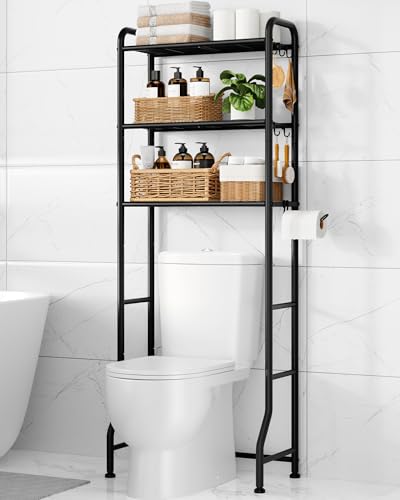
- CREATE VERTICAL STORAGE SPACE: Say goodbye to cluttered countertops and limited floor space! This over-the-toilet bathroom cabinet utilizes the unused area above your toilet
- PREMIUM CARBON STEEL: Crafted from high-quality carbon steel, this sturdy bathroom storage rack can support heavy loads without bending or breaking. Its waterproof and rustproof
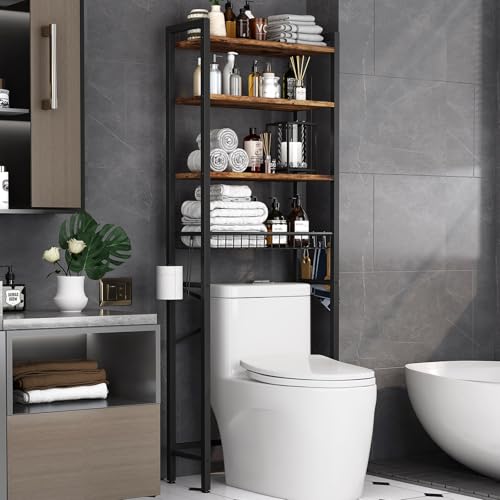
- [Utility Design] Our over the toilet storage shelf features three open shelves and 1 storage basket, along with 3 removable hooks and a toilet paper holder, providing ample
- [High-Quality & Style Go Beyond] 4-Tier-over-the-toilet storage rack Constructed with P2 particleboard thick wood panels and a sturdy metal frame, our shelf offers excellent
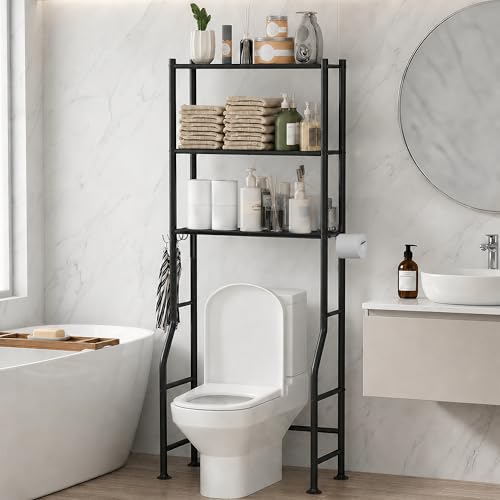
- [Maximize Vertical Space] - Utilize the often-ignored area above your commode to create an organized environment. With dimensions of 26"L x 8.6"W x 64"H, this freestanding unit
- [Enhanced Structural Stability] - Outfitted with a carbon steel frame and 4 dedicated anti-tilt kits, this organizer remains secure and balanced. The refined engineering addresses
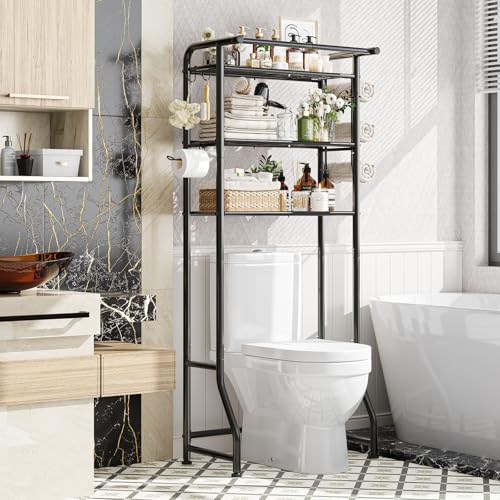
- 【Create Vertical Storage Space】This bathroom shelf cleverly utilizes the unused area above the toilet, providing ample storage capacity without taking up additional room. It can
- 【Unique Design】Featuring a three-tiered design with a towel rack and 3 hooks, this over the toilet rack effortlessly holds toilet paper, brushes, and other bathroom essentials
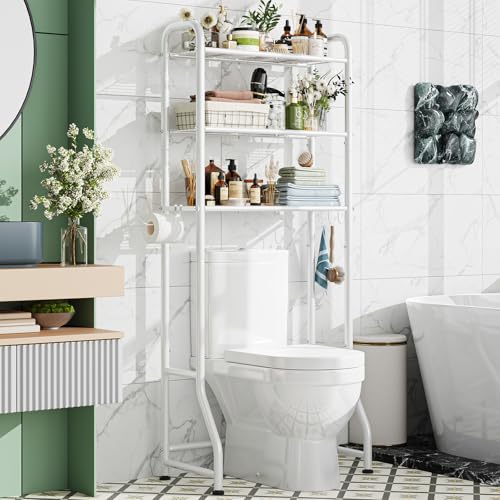
- 【Over Toilet Storage】The bottom shelf can easily fits into space behind your toilet. Featuring three mesh shelves, it provides ample storage for bathroom accessories, shampoo
- 【Sturdy and Stable】The 3-tier-over-the-toilet storage rack features a thickened iron pipe with a waterproof coating. Rust-resistant and easy to clean. The widened base design
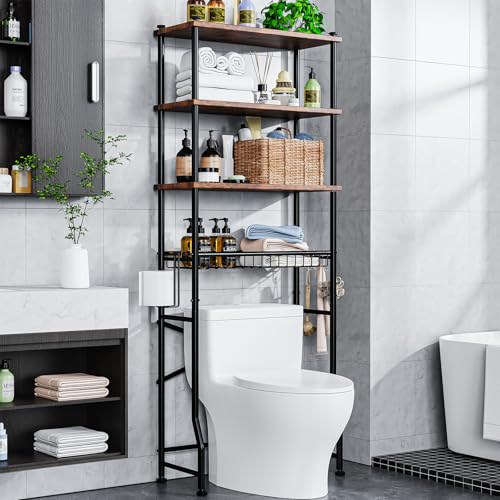
- Easy to Assemble: The over toilet bathroom organizer is designed with metal double-ended threaded studs, just twist the pipe, easy to assemble manually without tools; 4 adjustable
- Unique Design and Spacious Space: The overall size of this bathroom toilet rack is 24 x 11 x 65.5 inches. Our storage rack above the toilet is equipped with three open
How to choose the right size and material
Measure the clearance, not just the height. The number that actually determines fit is how far the bottom shelf sits above the floor. The GloTika states 38 inches; the Mlinavn states a 35.5-inch max base height. Measure from your floor to the top of your toilet tank lid, then add an inch or two so the lid can swing fully open. If your clearance number is under the unit's bottom-shelf height, the tank won't fit under it.
Measure depth against your walking path. Depth ranges from 8.6 inches (GloTika) to 13 inches (Simple Trending black). In a bathroom where the door swings toward the toilet or you sidle past to reach a shower, four inches is the whole ballgame. Tape the depth on your floor and live with it for a day before ordering.
Find your water supply valve first. The most common install frustration is a shutoff valve or supply hose blocking the bottom crossbar. The Kitsure offers optional upper/lower screw holes for the bottom tube, and the Mlinavn has an adjustable crossbar for inlet pipes at different heights. If your valve sits high, those two are the safer bets.
Steel vs. particleboard. Coated steel and carbon steel handle humidity better and clean with a wipe — the Kitsure, GloTika, and both Simple Trending units are metal. Particleboard shelves (Kalrin, Mlinavn) look warmer and give you a flat surface where small bottles won't tip through the gaps, but they're less forgiving of standing water and steam. If your bathroom has no exhaust fan, lean metal. If it does, the wood-look units are fine and generally nicer to look at.
Anchor it, whatever you buy. Every unit here ships with some anti-tip provision — wall-fixing kits, securing straps, or anti-tilt hardware. A 64-inch tower loaded with heavy items and no anchor is a hazard around kids and pets. Use the hardware in the box.
FAQ
What is an over-the-toilet storage cabinet used for? It converts the dead vertical space above your tank into shelving for towels, toilet paper, shampoo, cleaning supplies, and small plants. The units here also add hooks (three to five, depending on model) for robes and hand towels, plus built-in toilet paper holders. Several brands note the same racks work in laundry rooms, kitchens, and entryways.
How high should the cabinet sit above the toilet? High enough that the tank lid opens fully. Manufacturers state bottom-shelf clearances of 38 inches (GloTika) and up to 35.5 inches (Mlinavn). Measure floor-to-lid-top on your own toilet and compare — comfort-height toilets need more room than standard ones.
Are these hard to assemble? Most take basic tools and labeled hardware. The Mlinavn is the outlier: its frame uses double-ended threaded studs you twist together by hand, no tools required. The Kitsure includes an installation video, and the Simple Trending black model ships with an Allen key.
How much weight will the shelves hold? The two particleboard units state up to 30 lbs per layer. The steel models don't publish a per-shelf rating — Kitsure describes its carbon steel as supporting heavy loads without bending. If you're storing something genuinely heavy, check current listings and buyer reviews for real-world reports before loading up.
Related guides
- Alternative Options for Best storage and organization furniture - bookshelves, storage cabinets, closet organizers, shoe racks, storage benches, pantry cabinets, cube storage, ladder shelves, coat racks, over the toilet storage
- Best storage and organization furniture - bookshelves, storage cabinets, closet organizers, shoe racks, storage benches, pantry cabinets, cube storage, ladder shelves, coat racks, over the toilet storage with Limited History
- Best storage and organization furniture - bookshelves, storage cabinets, closet organizers, shoe racks, storage benches, pantry cabinets, cube storage, ladder shelves, coat racks, over the toilet storage for Small Business Owners
Key Takeaways
- Choosing the right best over the toilet storage means matching the key features to your specific needs and budget
- Read real customer reviews and check the return policy before you commit
- Compare value across models — the priciest option is not always the best fit