As an Amazon Associate this site earns from qualifying purchases.
Spec and compatibility table
| Product | Tiers | Dimensions (W×D×H) | Bottom clearance | Anti-tip hardware | Load rating | Price |
|---|---|---|---|---|---|---|
| Simple Trending Over The Toilet Storage Cabinet, Metal Bathroom Shelf Organizer with Paper Holder and Hooks, 3 Tier, Black | 3 | 24.25" × 13" × 64" | Not stated | Securing straps | Not stated | Check price on Amazon |
| GloTika 3-Tier Over Toilet Storage, Anti-Tilt, 64" H, Black | 3 | 26"L × 8.6"W × 64"H | 38" | 4 anti-tilt kits | Not stated | Check price on Amazon |
| Kitsure Over Toilet Storage Rack, 63.2" H Space-Saving, Holder & Hooks | 3 | Height 63.2"; W/D not stated | Not stated | 2 wall-fixing kits | Not stated | Check price on Amazon |
| Kalrin Over-The-Toilet Storage Rack, 4-Tier ... (Vintage Brown) | 4 (3 shelves + basket) | Not stated | Not stated | Wall fixing nails, X-frame crossbar | 30 lbs per layer | Check price on Amazon |
| Simple Trending Over The Toilet Storage Rack, Metal 3 Tier ... White | 3 | Not stated | Not stated | Securing straps | Not stated | Check price on Amazon |
| Over-The-Toilet Storage Shelf, 4-Tier ... (Brown) | 4 (3 shelves + basket) | 24" × 11" × 65.5" | 35.5" max base height | Wall fixing nails, X-frame, adjustable crossbar | 30 lbs per layer | Check price on Amazon |
Quick answer: Most over-the-toilet racks are freestanding frames that straddle the toilet — you assemble the legs and shelves on the floor, stand the unit up behind the bowl, level the feet, then anchor the top to the wall with the included strap or bracket kit. The two things that decide whether it goes smoothly are your tank-to-wall measurements and the position of your water supply valve, both of which you should check before opening the box. Budget 30–45 minutes, and don't skip the anti-tip hardware, because a tall metal frame loaded with towels is genuinely top-heavy.
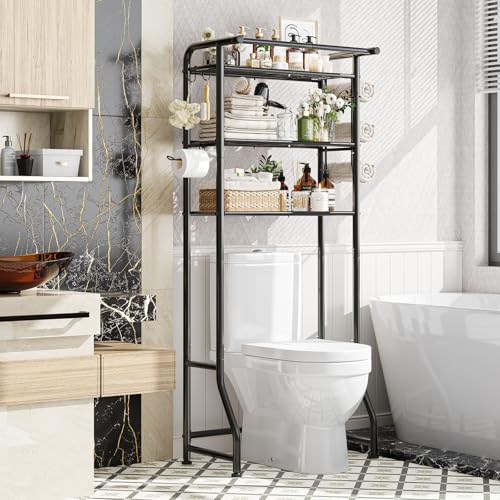
- 【Create Vertical Storage Space】This bathroom shelf cleverly utilizes the unused area above the toilet, providing ample storage capacity without taking up additional room. It can
- 【Unique Design】Featuring a three-tiered design with a towel rack and 3 hooks, this over the toilet rack effortlessly holds toilet paper, brushes, and other bathroom essentials
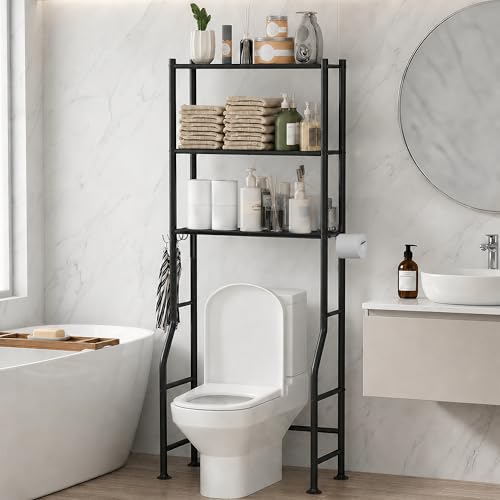
- [Maximize Vertical Space] - Utilize the often-ignored area above your commode to create an organized environment. With dimensions of 26"L x 8.6"W x 64"H, this freestanding unit
- [Enhanced Structural Stability] - Outfitted with a carbon steel frame and 4 dedicated anti-tilt kits, this organizer remains secure and balanced. The refined engineering addresses
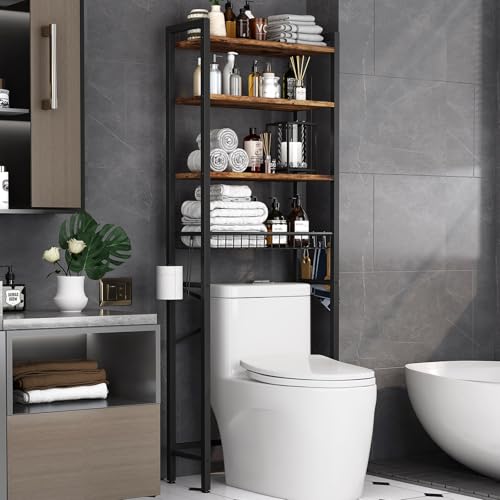
- [Utility Design] Our over the toilet storage shelf features three open shelves and 1 storage basket, along with 3 removable hooks and a toilet paper holder, providing ample
- [High-Quality & Style Go Beyond] 4-Tier-over-the-toilet storage rack Constructed with P2 particleboard thick wood panels and a sturdy metal frame, our shelf offers excellent
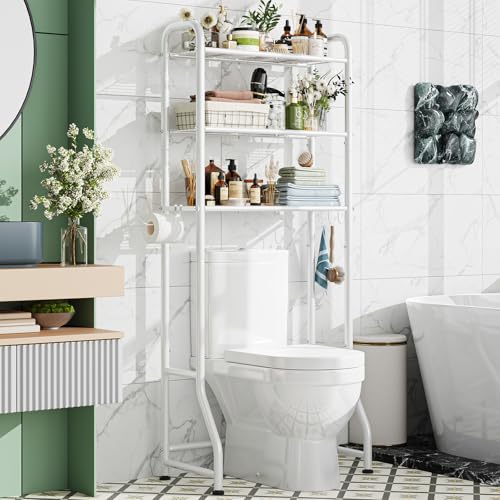
- 【Over Toilet Storage】The bottom shelf can easily fits into space behind your toilet. Featuring three mesh shelves, it provides ample storage for bathroom accessories, shampoo
- 【Sturdy and Stable】The 3-tier-over-the-toilet storage rack features a thickened iron pipe with a waterproof coating. Rust-resistant and easy to clean. The widened base design
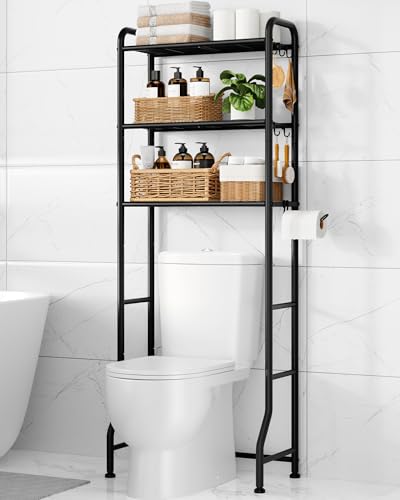
- CREATE VERTICAL STORAGE SPACE: Say goodbye to cluttered countertops and limited floor space! This over-the-toilet bathroom cabinet utilizes the unused area above your toilet
- PREMIUM CARBON STEEL: Crafted from high-quality carbon steel, this sturdy bathroom storage rack can support heavy loads without bending or breaking. Its waterproof and rustproof
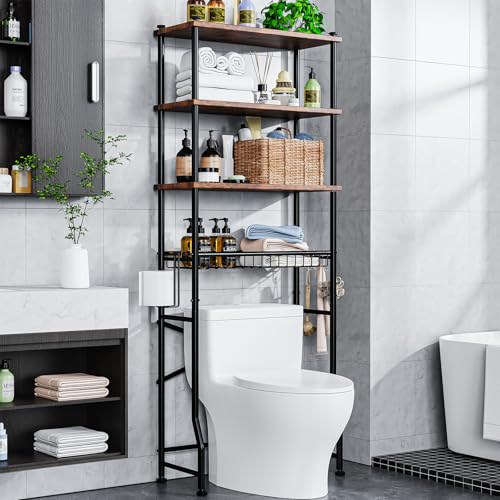
- Easy to Assemble: The over toilet bathroom organizer is designed with metal double-ended threaded studs, just twist the pipe, easy to assemble manually without tools; 4 adjustable
- Unique Design and Spacious Space: The overall size of this bathroom toilet rack is 24 x 11 x 65.5 inches. Our storage rack above the toilet is equipped with three open
Measure first: the five numbers that decide everything
Do this with a tape measure before you buy or unbox anything. Every install problem downstream traces back to one of these.
- Tank width. Add at least an inch of slop on each side. A unit listed at 24.25" wide will not clear a 24" tank opening in practice once the legs are in place.
- Floor to top of tank lid. This is your minimum bottom-shelf clearance. The GloTika 3-Tier Over Toilet Storage, Anti-Tilt, 64" H, Black lists its bottom shelf at 38 inches from the floor; the Over-The-Toilet Storage Shelf,4-Tier Bathroom Organizer Cabinet Rack And Storage Over Toilet With Shelf Waterproof Feet Pad And Basket,Multifunctional Space Saver Freestanding Bathroom Shelves(Brown) lists a maximum base-area height of 35.5 inches. Those are different toilets.
- Lid swing. Open the tank lid and the seat fully. Measure the highest point either reaches. A shelf that clears the closed lid but blocks the open one is a plumbing headache waiting to happen.
- Wall to back of tank. Rear legs need floor. If your tank sits flush to the wall, the legs have to go beside the toilet, not behind it — check the unit's depth against your available footprint.
- Ceiling height. These frames run 63–65 inches. Fine in most bathrooms, not fine under a sloped ceiling or a low soffit.
Step-by-step assembly and install
Step 1 — Inventory the parts on a towel. Lay everything out and match it to the parts list. Most of these kits label their components; the Kitsure Over Toilet Storage Rack, 63.2" H Space-Saving, Holder & Hooks ships with a complete accessory kit, step-by-step instructions and an installation video, and the Simple Trending Over The Toilet Storage Cabinet, Metal Bathroom Shelf Organizer with Paper Holder and Hooks, 3 Tier, Black includes an Allen key. Gotcha: small hardware bags love bathroom floor drains. Work on a towel, close the drain.
Finding the right how to install over the toilet storage comes down to matching the features to how you will actually use it.
Step 2 — Build upside down or on its side. Metal tube frames go together far more easily lying flat than standing. Thread every connection loosely first, get all four legs and all shelves engaged, then tighten. Tightening as you go is how you end up with a frame that won't accept the last shelf.
Step 3 — Set the bottom crossbar around your supply valve. This is the step people don't see coming. The shutoff valve and supply line on the left rear of most toilets sit exactly where a bottom rail wants to be. Some units plan for this: the Kitsure Over Toilet Storage Rack, 63.2" H Space-Saving, Holder & Hooks has optional screw holes so you can mount the bottom tube high or low depending on valve position, and the Over-The-Toilet Storage Shelf,4-Tier Bathroom Organizer Cabinet Rack And Storage Over Toilet With Shelf Waterproof Feet Pad And Basket,Multifunctional Space Saver Freestanding Bathroom Shelves(Brown) uses an adjustable crossbar for the same reason. If yours doesn't, you may need to rotate the frame so the crossbar clears.
Step 4 — Walk it into place, don't slide it. Lift and set. Sliding drags the feet and can chip tile grout or scratch vinyl.
Step 5 — Level before you anchor. Bathroom floors are rarely flat, especially near a wax-ring bulge. Adjustable feet exist for this — the Kitsure Over Toilet Storage Rack, 63.2" H Space-Saving, Holder & Hooks has four adjustable leveling feet. Rock the unit corner to corner and adjust until it's dead still.
Step 6 — Anchor it. Not optional. Every unit here ships anti-tip hardware of some kind: securing straps on both Simple Trending racks, four anti-tilt kits on the GloTika 3-Tier Over Toilet Storage, Anti-Tilt, 64" H, Black, two wall-fixing kits on the Kitsure, and wall fixing nails on the Kalrin Over-The-Toilet Storage Rack, 4-Tier Bathroom Organizer Shelf Over Toilet with Adjustable Shelf and Basket, Freestanding Space Saver Bathroom Shelves Above Toilet for Room (Vintage Brown). Find a stud if you can. If you can't, use a drywall toggle rated well above the loaded weight of the shelf — a plastic conical anchor is not enough.
Step 7 — Load bottom-heavy. Detergent, spare rolls and anything with mass goes on the lowest shelf. Light towels and decor up top. This is free stability.
What goes wrong, and how to fix it
The unit rocks front-to-back. Symptom: touching the top shelf makes the whole thing sway. Fix: almost always uneven feet, not a bad frame. Adjust the leveling feet or shim the short leg, then re-tighten every joint — a single loose shelf connection turns a rigid frame into a parallelogram.
Bottom rail sits on the water supply line. Symptom: the frame won't sit flat, or one leg floats. Fix: use the alternate screw holes or adjustable crossbar if the unit has them; otherwise rotate the frame 180° so the rail clears the valve side.
Tank lid won't lift. Symptom: you can't get the lid off to fix a running flapper. Fix: raise the bottom shelf if it's adjustable, or move the unit forward an inch. Check this on install day, not the night your toilet starts running.
Shelf sags under load. Symptom: visible bow in a wood shelf. Fix: respect the per-shelf limit. Both the Kalrin Over-The-Toilet Storage Rack, 4-Tier Bathroom Organizer Shelf Over Toilet with Adjustable Shelf and Basket, Freestanding Space Saver Bathroom Shelves Above Toilet for Room (Vintage Brown) and the Over-The-Toilet Storage Shelf,4-Tier Bathroom Organizer Cabinet Rack And Storage Over Toilet With Shelf Waterproof Feet Pad And Basket,Multifunctional Space Saver Freestanding Bathroom Shelves(Brown) are rated to 30 lbs per layer.
Rust spots at the joints within months. Symptom: orange bloom where tubes meet. Fix: prevention only — wipe standing water off, run the exhaust fan, and choose a coated frame. Waterproof/rustproof coatings are listed on the Simple Trending, GloTika and Kitsure units.
Small parts vanish mid-build. Symptom: one screw short at step 6. Fix: count hardware against the parts list before you start, and contact the seller for a replacement rather than improvising with a hardware-store screw of the wrong thread.
Check the current listing before ordering — dimensions and prices change.
When the fix is a new one
Sometimes the rack you own simply doesn't fit your toilet, and no amount of shimming saves it. These are worth looking at, each for a specific reason.
Simple Trending Over The Toilet Storage Cabinet, Metal Bathroom Shelf Organizer with Paper Holder and Hooks, 3 Tier, Black — published dimensions you can pre-check
GloTika 3-Tier Over Toilet Storage, Anti-Tilt, 64" H, Black — a stated bottom-shelf height
Kitsure Over Toilet Storage Rack, 63.2" H Space-Saving, Holder & Hooks — designed around the supply valve
Kalrin Over-The-Toilet Storage Rack, 4-Tier Bathroom Organizer Shelf Over Toilet with Adjustable Shelf and Basket, Freestanding Space Saver Bathroom Shelves Above Toilet for Room (Vintage Brown) — adjustable shelf spacing
Simple Trending Over The Toilet Storage Rack, Metal 3 Tier Bathroom Organizer Shelf with Paper Holder and 3 Hooks, Freestanding Shelf Space Saver Above Toilet, White — a widened base for rocking floors
Over-The-Toilet Storage Shelf,4-Tier Bathroom Organizer Cabinet Rack And Storage Over Toilet With Shelf Waterproof Feet Pad And Basket,Multifunctional Space Saver Freestanding Bathroom Shelves(Brown) — tool-free assembly and an adjustable crossbar
FAQ
Do I really have to drill into the wall? The frame will stand on its own, but a loaded 64-inch rack has a high center of gravity and a bathroom is a room where people grab things for balance. Use the anti-tip kit that came in the box. If you're in a rental, a toggle bolt leaves a hole you can patch with spackle in two minutes.
What if there's no stud behind the toilet? Common — the drain stack often eats that bay. Use a heavy-duty drywall toggle rather than the plastic anchor in the bag, and if you're near the stack, drill shallow and probe first.
Will it fit a one-piece or elongated toilet? Check bottom-shelf clearance against your tank height and the width against your widest point. One-piece toilets often have a taller tank profile, which is where a stated clearance figure like the GloTika's 38 inches earns its keep.
How much weight can these hold? Only two units here publish a figure — the Kalrin and the Mlinavn 4-tier, both at 30 lbs per layer. For the rest it isn't stated, so keep heavy items low and check the listing and current owner reviews on the product page yourself before loading anything substantial.
Related guides
- Get a Best storage and organization furniture - bookshelves, storage cabinets, closet organizers, shoe racks, storage benches, pantry cabinets, cube storage, ladder shelves, coat racks, over the toilet storage Quote
- Best storage and organization furniture - bookshelves, storage cabinets, closet organizers, shoe racks, storage benches, pantry cabinets, cube storage, ladder shelves, coat racks, over the toilet storage Requirements Explained
- Best storage and organization furniture - bookshelves, storage cabinets, closet organizers, shoe racks, storage benches, pantry cabinets, cube storage, ladder shelves, coat racks, over the toilet storage with Self-Employment
Key Takeaways
- Choosing the right how to install over the toilet storage means matching the key features to your specific needs and budget
- Read real customer reviews and check the return policy before you commit
- Compare value across models — the priciest option is not always the best fit