As an Amazon Associate this site earns from qualifying purchases.
Specifications compared
| Product | Overall size (W × D × H) | Tiers | Shelf clearance | Stated load | Material | Price |
|---|---|---|---|---|---|---|
| GDFStudio 65" Tall L-Shaped Corner Bookshelf (Long Right) | 35.43" × 21.65" × 64.56" | 6 | 11.81" | 30 lbs/shelf | 15mm MDF | Check price on Amazon |
| Furnify 71" Tall Bookshelf with Drawer, Black | 19.7" × 13.8" × 71" | Not stated (3 adjustable shelves + drawer + cabinet) | Adjustable | Not stated | CARB/EPA certified wood | Check price on Amazon |
| Arvolia 6 Tier Corner Bookshelf (Light Gray, Right Extension) | 21.65" × 21.65" × 64.57" | 6 | 11.81" | Not stated | 15mm wood-grain particle board | Check price on Amazon |
| Arvolia 5 Tier Corner Bookshelf (Dark Oak, Right Extension) | 21.65" × 21.65" × 64.57" | 5 | 11.81" | Not stated | 15mm wood-grain particle board | Check price on Amazon |
| Suitable for 72.8in L-Shaped Corner Bookshelf, Black Full Panel | 35.4" × 35.4" × 72.8" | 5 | Not stated (lower 2 tiers taller by 4.33") | 60 lbs/tier | Scratch-resistant MDF | Check price on Amazon |
| 35.43" Size 5-Tier L-Shaped Corner Bookshelf (Light Gray) | 35.43" × 21.65" × 64.56" | 5 | 11.81" | 30 lbs/shelf | 15mm MDF | Check price on Amazon |
Quick answer: Measure the wall (or corner) first, then match the shelf to the tallest books you actually own — most tall bookcases in this class give about 11.81 inches of clearance per tier, which handles hardcovers but not oversized art books. If you have floor space, a straight narrow unit like the Furnify 71" Tall Bookshelf with Drawer wastes the least wall; if you have an awkward empty corner, an L-shaped unit turns dead space into 5 or 6 tiers without eating your walkway.
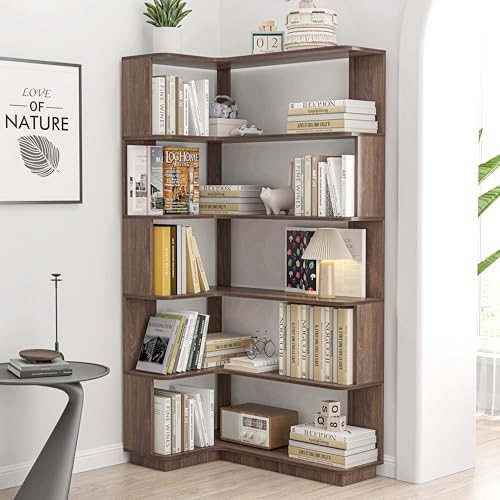
- 【Space Saving L Shaped Corner Design】Designed as a functional corner shelf to fit neatly against the wall, this tall bookcase maximizes unused corners and enhances space
- 【Spacious 6 Tier Storage Capacity】Overall size: 35.43"W × 21.65"D × 64.56"H. The extended 35.43"W side offers generous room for books, bookends, decor, figures, and storage
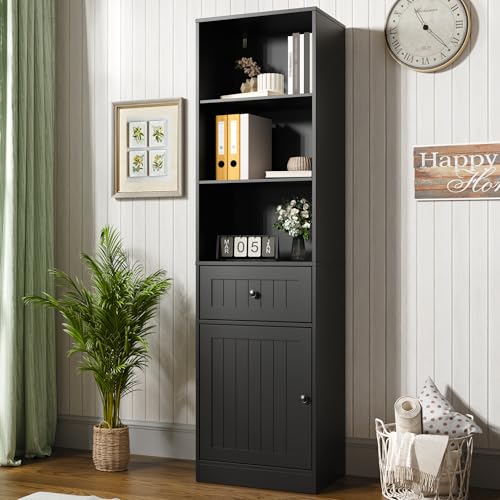
- Adjustable & Ample Storage Capacity: This bookshelf features 1 drawer and 1 cabinet with door, providing ample storage space for your belongings. There is a 3 height-adjustable
- Farmhouse Modern Design: This bookcase features sleek striped shaker panels and smooth rounded knobs, offering a modern design. Inspired by rustic charm, its refined and
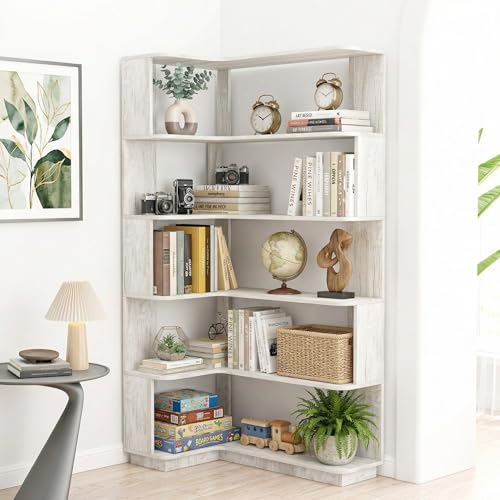
- 【6-Tier L-Shaped Corner Design】Designed with a 90° L-shaped structure, this corner bookshelf fits neatly against walls to maximize unused corner space. The vertical 6-tier open
- 【Space-Saving Size for Daily Storage】Overall size: 21.65"L x 21.65"W x 64.57"H, with 11.81" height between shelves. Ideal for storing books, décor, plants, and daily essentials
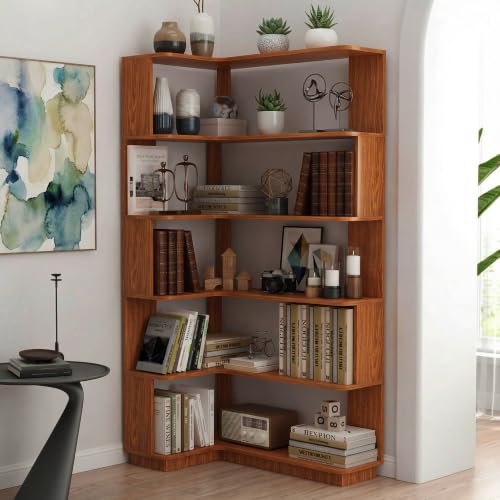
- 【5-Tier L-Shaped Corner Design】Designed with a 90° L-shaped structure, this corner bookshelf fits neatly against walls to maximize unused corner space. The vertical 5-tier open
- 【Space-Saving Size for Daily Storage】Overall size: 21.65"L x 21.65"W x 64.57"H, with 11.81" height between shelves. Ideal for storing books, décor, plants, and daily essentials
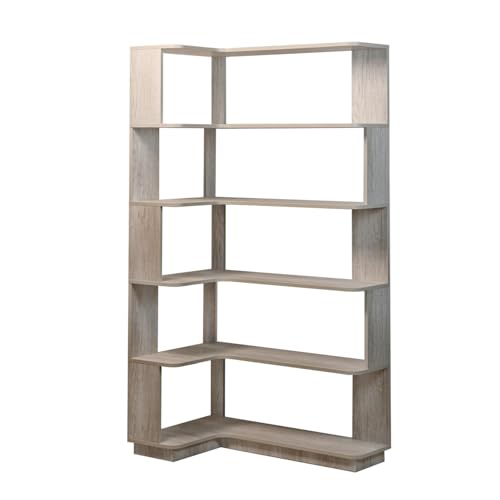
- 【Space saving corner design】:Featuring L-shaped design to perfectly fit the wall, maximizes the value of the corner for you and increases the space utilization; Adding a touch of
- 【Overall size】:35.43"L x 21.65"W x 64.56"H, 90cm extended length size for more books and magazines storage. 50cm width can easily match with other furniture products. The height
The three measurements that actually decide it
Almost every "wrong bookshelf" story comes down to one of three numbers.
Footprint depth. A 21.65" deep corner unit sticks out roughly two feet into the room from each wall. In a bedroom with a 30" walking lane, that's a shin magnet. A 13.8" deep narrow bookcase, by contrast, is about the depth of a standard hardcover plus a little breathing room.
Finding the right how to choose the right bookshelf comes down to matching the features to how you will actually use it.
Shelf clearance, not total height. A 64.56" bookcase with six tiers gives 11.81" between shelves. Standard hardcovers (about 9.5") fit. Textbooks, LP records, and coffee-table books frequently do not. If your collection is oversized, you want fewer, taller tiers — or adjustable shelves.
Load per shelf. Books are heavy: a packed 35" shelf of hardcovers can push past 40 lbs. The units below that state a rating land at 30 lbs or 60 lbs per shelf. That single number is the difference between straight shelves in year three and a visible sag.
A corner unit that earns its footprint
For most people staring at an unused corner, the GDFStudio 65" Tall L-Shaped Corner Bookshelf, 6-Tier Freestanding Corner Shelf Bookcase with Anti-Drop Panel, Wooden Open Back Display Shelves Organizer for Living Room, Dark Brown (Long Right) hits the useful middle. The 35.43"-wide long side gives you a genuine run of shelf for books rather than a stack of tiny display cubbies, while the short side tucks against the adjoining wall. Six tiers at 11.81" clearance and a stated 30 lbs per shelf means roughly 180 lbs of total rated capacity across the unit, and the raised side panels are there to stop books sliding off the open ends. It's 15mm MDF with a reinforced base and a 3D wood-grain surface — decent for the money, not solid timber.
Note what the listing does not say: it describes anti-drop panels but no anti-tipping hardware. If you have kids or pets, budget for a separate anti-tip strap kit and anchor it to a stud.
Who this kind of bookshelf is for
- You have an empty corner and a room too small for a long straight bookcase.
- Your collection is mostly standard hardcovers and paperbacks under about 11 inches tall.
- You want open display as much as storage — plants, framed photos, figures, baskets.
- You're renting and want something freestanding you can disassemble and move.
Who should skip it
- Oversized book owners. Art books, vinyl, and binders will not fit a fixed 11.81" tier. Look for adjustable shelving instead.
- Anyone with a tight walkway. A 21.65" deep corner unit is a real obstacle in a hallway or narrow bedroom.
- People who need things hidden. These open corner units display everything, dust included. If you want doors, that's a different category.
- Heavy-load users. If you're shelving reference books wall-to-wall, a 30 lbs-per-shelf rating is your ceiling, not a suggestion.
The honest trade-offs
Engineered wood at this price is a genuine compromise. MDF and particle board are dimensionally stable and cheap, but they sag under sustained load in a way solid wood doesn't, and a shelf that has bowed does not un-bow. Load the heaviest books on the bottom two tiers.
Open-back designs look lighter and improve airflow, but they also mean the wall behind becomes part of the look — scuffed rental drywall will show. The 72.8" Black Full Panel unit is the exception here, with a removable back panel you can choose to install.
Assembly is the other tax. Multi-tier L-shaped units have a lot of panels and cam locks. Budget an hour or two, and do not skip the anti-tip hardware where it's included.
What to check on the listing before you buy
Listings change more often than articles do. Before checkout, confirm:
- Current price. Every figure above is a snapshot and furniture pricing moves constantly.
- The variant. These corner units are sold in mirrored orientations — "Left Short, Right Long" versus a left extension. Order the wrong hand and it won't sit in your corner. Colour options often carry different prices too.
- Whether anti-tipping hardware is in the box. Some of these state it explicitly, some don't.
- Warranty and return terms, including who pays return shipping on a large item.
- Recent reviews yourself — read the one- and two-star ones specifically, and look at customer photos for shelf sag and finish quality.
Alternatives worth a look
Furnify 71" Tall Bookshelf with Drawer, Farmhouse Narrow Bookcase, Black — consider instead if…
…you don't have a corner to spare. The Furnify 71" Tall Bookshelf with Drawer, Farmhouse Narrow Bookcase, Black is 19.7" wide and only 13.8" deep, so it hugs a wall in a way no L-shaped unit can. It's also the only option here with genuinely adjustable shelving — three height-adjustable shelves inside — plus a drawer and a cabinet with a reversible door for the stuff you'd rather not display. It's made from CARB/EPA certified wood and includes a wall anchor kit. Shelf load isn't stated, so treat it as a display-and-tidy piece rather than a reference library.
Arvolia 6 Tier Corner Bookshelf — consider instead if…
…your corner is genuinely tight. The Arvolia 6 Tier Corner Bookshelf, Freestanding L-Shaped Wooden Bookcase with Open Shelves, Anti-Fall Panels and Anti-Tipping Device for Living Room, Home Office (Light Gray with Right Extension) is 21.65" square rather than 35" on the long side, so it takes up less wall while still stacking six tiers at 11.81" clearance. It ships with an anti-tipping device, which the GDFStudio listing doesn't mention.
Arvolia 5 Tier Corner Bookshelf — consider instead if…
…you want the same compact 21.65" square footprint but prefer a darker finish and fewer, uninterrupted tiers. The Arvolia 5 Tier Corner Bookshelf, Freestanding L-Shaped Wooden Bookcase with Open Shelves, Anti-Fall Panels and Anti-Tipping Device for Living Room, Home Office (Dark Oak with Right Extension) is the same 64.57" height and price as its six-tier sibling — you're trading one shelf for a slightly less busy look.
Suitable for 72.8in L-Shaped Corner Bookshelf — consider instead if…
…you need real load capacity and a closed back. The Suitable for 72.8in L-Shaped Corner Bookshelf - Farmhouse Style 5-Tier Tall Wooden Bookcase for Storage & Display - Ideal for Living Room & Bedroom - Black Full Panel states 60 lbs per tier — double the rating of the 30 lbs units — and its lower two tiers are 4.33" taller for baskets and bulkier items. It's also the biggest thing here at 72.8" tall and 35.4" on both sides, and it can be split into two shorter units, which is unusual and genuinely handy in a kids' room.
35.43" Size 5-Tier L-Shaped Corner Bookshelf — consider instead if…
…you want the wide 35.43" long side on a smaller budget. The 35.43" Size 5-Tier L-Shaped Corner Bookshelf For Living Room, Bedroom, Home Office Wooden Bookcase With Anti-Drop Panel And Anti Tipping Device, Open Storage, Left Short, Right Long (Light Gray) matches the GDFStudio's 35.43" × 21.65" × 64.56" footprint and 30 lbs per shelf rating with one fewer tier, and includes two sets of anti-tipping devices plus rounded corners.
FAQ
How do I choose the right size bookshelf for my space? Tape the footprint onto your floor before ordering. Mark 21.65" out from each wall for a corner unit, or 13.8" for a narrow one, and live with the tape for a day. Then measure your tallest book and compare it to the stated shelf clearance — 11.81" is the common figure here.
Are corner bookshelves actually good for books? They're good for the corner, which would otherwise hold nothing. But the inner corner of an L-shape is awkward to reach into, so it's better suited to decor than to books you pull out weekly. Put your working reading on the long side.
Is MDF or particle board strong enough? For normal household loads, yes — as long as you respect the stated rating. The 15mm MDF units above are rated at 30 lbs per shelf and the thicker Black Full Panel unit at 60 lbs per tier. Overloading is what causes sag, not the material by itself.
Do I really need to anchor a bookshelf to the wall? Yes, on anything this tall — a 64"–73" unit is a tipping hazard once loaded, especially with children or pets in the house. Several of these include anti-tipping hardware; if yours doesn't, buy a strap kit and anchor into a stud, not just drywall.
Related guides
- Sauder Carson Forge Bookcase Review: What to Know
- Best storage and organization furniture - bookshelves, storage cabinets, closet organizers, shoe racks, storage benches, pantry cabinets, cube storage, ladder shelves, coat racks, over the toilet storage with Past Challenges
- The Best Cube Storage Organizers for Every Room
Key Takeaways
- Choosing the right how to choose the right bookshelf means matching the key features to your specific needs and budget
- Read real customer reviews and check the return policy before you commit
- Compare value across models — the priciest option is not always the best fit